

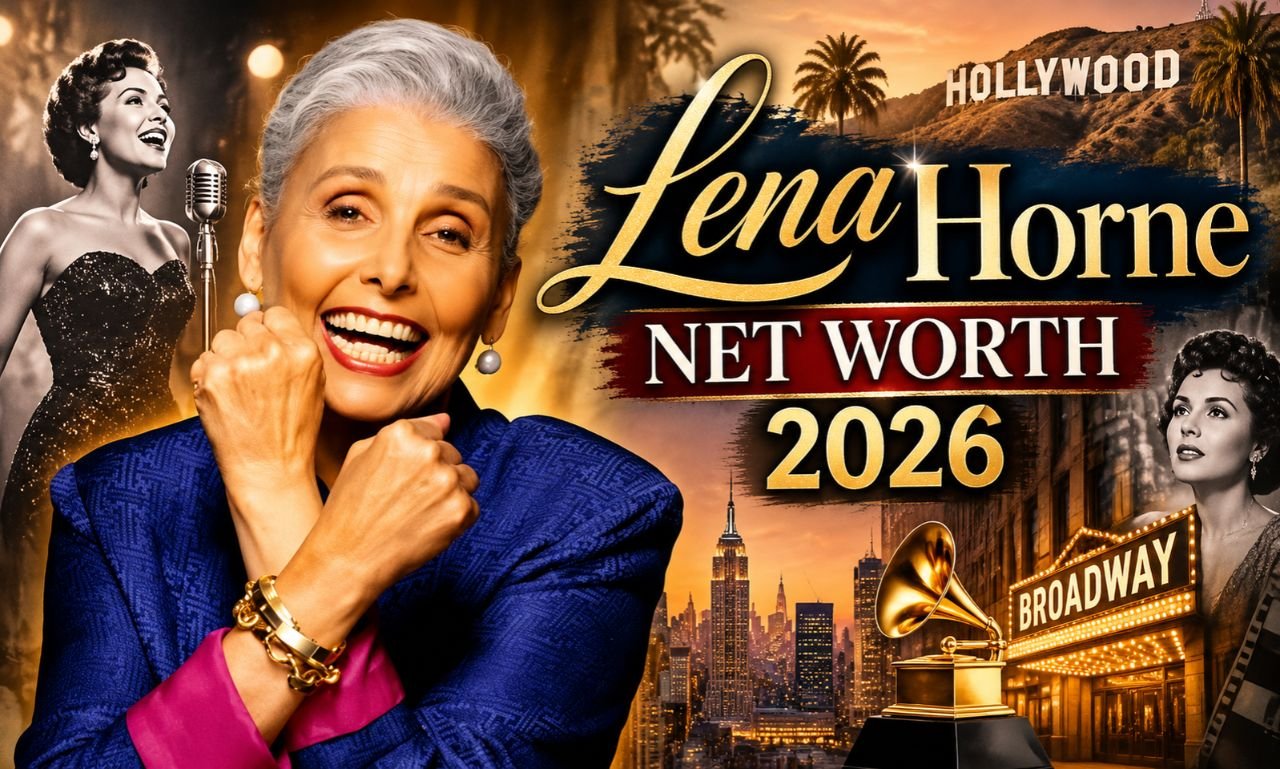
Lena Horne net worth is a subject of interest among fans of classic Hollywood, jazz music, and Broadway entertainment. The American singer and actress had an estimated net worth of $10 million at the time of her death in 2010, according to Celebrity Net Worth. The publication also gives an inflation-adjusted equivalent of approximately $14 million in its published profile. However, neither figure represents an independently verified assessment of her estate in 2026.
Horne built her fortune through decades of nightclub performances, recording contracts, Hollywood films, television appearances, and Broadway productions. Her financial legacy also includes valuable Manhattan real estate and personal possessions sold through estate auctions. This article examines her estimated wealth, professional earnings, career milestones, known assets, and the financial evidence available today.
Lena Horne Quick Facts
| Category | Details |
| Full Name | Lena Mary Calhoun Horne |
| Date of Birth | June 30, 1917 |
| Date of Death | May 9, 2010 |
| Age at Death | 92 years |
| Birthplace | Brooklyn, New York, USA |
| Nationality | American |
| Profession | Singer, Actress, Dancer, Civil Rights Activist |
| Years Active | 1933–2000 |
| Estimated Net Worth | $10 million at death (unverified estimate) |
| Main Income Sources | Music, films, concerts, television, Broadway |
| Famous Song | Stormy Weather |
| Famous Film | Stormy Weather (1943) |
| Notable Broadway Production | Lena Horne: The Lady and Her Music |
| Major Recognition | Special Tony Award, Grammy Awards, Kennedy Center Honor |
Sources: Celebrity Net Worth, PBS American Masters, Academy of Motion Picture Arts and Sciences, and IBDB.
Celebrity Net Worth+3
Lena Horne Net Worth in 2026: What Is the Most Credible Estimate?
The most clearly identifiable published estimate places Lena Horne’s net worth at $10 million when she died in May 2010. Celebrity Net Worth reports this figure in its biography of the entertainer and describes it as an estimate rather than a verified financial statement.
The important distinction is that Horne was no longer alive in 2026. Consequently, it would be misleading to describe $10 million as her current personal wealth or suggest that she continued earning a salary after 2010.
Her estate, however, continued to deal with assets after her death. Manhattan apartments associated with her were sold or listed in subsequent years, and personal belongings were auctioned in 2011.
Why Do Different Websites Report Different Figures?
Online biographies do not agree on Horne’s estimated wealth.
- Celebrity Net Worth: Reports approximately $10 million at the time of her death in 2010.
- Super Stars Bio: Lists an approximate net worth of $30 million, without providing a transparent financial calculation.
- Other online estimates: Some repeat figures without identifying the valuation date, underlying assets, or financial methodology.
These numbers should not be treated as equally reliable financial evidence. Super Stars Bio’s $30 million figure is not supported by a documented estate valuation in the material available for this article.
For that reason, the $10 million estimate is the more useful published reference point, but it remains unverified.
Celebrity Net Worth also explains that its estimates are assembled from publicly available information and are not necessarily independently audited.
Celebrity Net Worth+1
What Does the $10 Million Figure Actually Mean?
Net worth represents the difference between a person’s assets and liabilities.
For an entertainer such as Horne, potential assets could have included:
- Real estate holdings.
- Cash and financial investments.
- Music-related intellectual property.
- Recording royalties and contractual rights.
- Personal collections, jewelry, and artwork.
- Other property and financial interests.
However, publicly available information does not provide a complete balance sheet showing the value of every asset and outstanding liability she owned in 2010.
The $10 million estimate should therefore be understood as a published approximation, not a confirmed inheritance amount or an official probate valuation.
Who Was Lena Horne?
Lena Horne was an American singer, actress, dancer, and civil rights activist whose career spanned more than six decades. Born in Brooklyn, New York, she became one of the most recognizable African American entertainers of the twentieth century. Her smooth singing voice, elegant stage presence, and determination to challenge racial discrimination helped establish her as a significant figure in American entertainment.
Horne achieved international recognition through music, Hollywood productions, nightclub performances, and Broadway theater. Her performance of “Stormy Weather” became particularly associated with her identity as an artist. The song remains one of the most recognizable recordings connected with classic American entertainment.
Beyond her artistic achievements, she used her public position to speak against racial segregation and discrimination. According to the Academy of Motion Picture Arts and Sciences, Horne developed a career across movies, music, and theater while refusing many stereotypical roles offered to African American performers.
Early Life and Education
Lena Mary Calhoun Horne was born on June 30, 1917, in Brooklyn, New York. Her family had connections to education, business, and civil rights organizations. Her grandmother, Cora Calhoun Horne, was particularly influential during her childhood and introduced her to organizations working for racial equality.
Her mother, Edna Louise Scottron, worked as an actress and traveled frequently. Her father, Edwin Fletcher Horne Jr., was involved in business. Horne spent parts of her childhood living with family members and was exposed to the social and cultural environment of African American communities in New York.
She attended school in Brooklyn, including Girls’ High School. However, her education was interrupted when her mother encouraged her to pursue an opportunity in entertainment. At just 16 years old, Horne joined the chorus line at Harlem’s famous Cotton Club.
This opportunity became the beginning of a professional career that would eventually bring her international recognition. Her early experiences also influenced her understanding of racial inequality, a subject that remained important throughout her life.
Career Beginnings at the Cotton Club
Horne began performing professionally in 1933 at the Cotton Club in Harlem. The nightclub was one of the most prominent entertainment venues in New York during the Harlem Renaissance era. It featured leading musicians, singers, dancers, and orchestras. Although African American performers entertained audiences there, the club maintained discriminatory admission policies toward Black customers.
Working at the Cotton Club exposed Horne to professional musicians, composers, and performers. It also helped her develop the stage confidence and musical skills needed for a successful entertainment career. In 1934, she made her Broadway debut in Dance With Your Gods.
She later performed with Noble Sissle’s orchestra and developed her experience as a vocalist. Her early career also included appearances with the Charlie Barnet Orchestra, an important opportunity because she became one of the early African American singers to perform with a prominent white swing band.
These experiences helped establish her reputation beyond New York’s nightclub scene. Although her early performances did not immediately make her wealthy, they created the professional foundation for her later film, recording, and stage opportunities.
Hollywood Breakthrough and Major Film Achievements
Horne’s Hollywood breakthrough significantly expanded her professional reputation. In 1938, she appeared in The Duke Is Tops, which marked an important early film credit. Her career advanced further when she joined MGM in 1942. She became one of the first African American performers to sign a long-term contract with a major Hollywood film studio.
This agreement was an important achievement during an era when Black performers faced considerable restrictions in the film industry. Her most memorable film appearances included:
- Panama Hattie (1942).
- Cabin in the Sky (1943).
- Stormy Weather (1943).
- Thousands Cheer (1943).
- Broadway Rhythm (1944).
- Ziegfeld Follies (1946).
- The Wiz (1978).
Her performance in Stormy Weather became one of the defining moments of her film career. Despite her popularity, Horne often received limited dramatic roles. Studios sometimes treated her musical performances as separate sequences that could be removed when films were distributed to theaters enforcing racial segregation.
This restricted her opportunities compared with many white Hollywood stars. Nevertheless, her talent, professionalism, and determination helped her maintain a successful career. Her film work contributed to her professional earnings and established her as an important figure in Hollywood history.
How Did Lena Horne Make Her Money?
Lena Horne developed several professional income sources throughout her career. Rather than relying entirely on film contracts, she worked across the music, theater, television, and live entertainment industries. Her main documented professional activities included:
| Income Source | Career Contribution |
| Live performances | Nightclubs, concerts, and international appearances |
| Music recordings | Albums and recording contracts |
| Hollywood films | Acting and musical performances |
| Broadway | Musical theater and her one-woman production |
| Television | Specials, guest appearances, and performances |
| Music-related rights | Potential continuing royalty income from recordings and related rights |
The exact amount Horne earned from each category has not been established through a publicly available consolidated financial record.
1. Nightclub Performances and Concerts
Live entertainment was one of Horne’s most important professional activities. She performed at prominent venues in New York and other major cities, developing a reputation as an accomplished nightclub singer. Her career included performances at venues such as Café Society and the Waldorf-Astoria.
According to Blue Note Records, nightclub entertaining remained her primary professional occupation for more than 60 years, from the 1930s through the 1990s. Live performances provided opportunities to earn fees from individual engagements, concert appearances, and extended entertainment contracts.
Her ability to perform internationally also allowed her to reach audiences beyond the American entertainment industry. Unlike a film appearance, a concert performance allowed Horne to connect directly with audiences through her voice, personality, and stage presence. This became an important part of her long-term professional success.
2. Music Albums and Recording Contracts
Music was another major part of Horne’s career.
She recorded songs across jazz, blues, traditional pop, and musical theater.
Her recording career began in the 1930s and continued into 2000.
Her association with RCA Victor and other recording labels helped her establish a substantial catalog of music.
One particularly important release was Lena Horne at the Waldorf-Astoria, a live recording that became a significant commercial success.
Her albums included performances of classic American standards and songs that demonstrated her vocal range.
Recording contracts could provide income through advances, recording fees, and contractual royalty arrangements. However, the precise terms of Horne’s agreements and the amounts she personally received are not comprehensively documented in public sources.
It is therefore not possible to calculate her lifetime recording income accurately.
Her music remains an important part of her artistic legacy.
3. Broadway Performances
Broadway became another important source of professional recognition and potential earnings. In 1957, Horne starred in Jamaica, a musical opposite Ricardo Montalban. Her performance earned her a Tony Award nomination for Best Actress in a Musical. The production ran for 555 performances, making it an important stage achievement. However, her most celebrated Broadway production came later.
In 1981, she launched Lena Horne: The Lady and Her Music. The production was originally expected to have a relatively short engagement, but its success resulted in an extended run. The show ran for approximately 13 months and became one of the defining achievements of her later career.
It earned Horne a Special Tony Award, while its recording received two Grammy Awards. A successful Broadway production can generate income through performance compensation and contractual arrangements, but its total box-office revenue should not be confused with an individual performer’s personal earnings.
4. Television Appearances
Horne also worked in television, appearing in entertainment programs and musical specials. Television allowed her to reach audiences who might never have attended her live performances or watched her films in theaters.
Her appearances included programs such as:
- The Cosby Show.
- A Different World.
- Sanford and Son.
- Rowan & Martin’s Laugh-In.
- The Tonight Show Starring Johnny Carson.
Television work expanded her public visibility and provided another professional platform. Depending on the production, television appearances could generate compensation through guest-performance fees, production agreements, and other contractual arrangements. However, no reliable public record provides a complete total of her television earnings.
IBDB+1
Lena Horne’s Real Estate and Manhattan Properties
Real estate is one of the more tangible aspects of Horne’s financial history. According to Celebrity Net Worth, she lived in different parts of Southern California before making New York her full-time home in the early 1980s.
In 1985, she purchased an apartment at 23 East 74th Street, near Madison Avenue in Manhattan. The property later became associated with several residential units. Celebrity Net Worth reports that Horne eventually purchased four additional units in the building. She used one as her residence, while the others served as guest apartments, office space, and storage.
Following her death, the estate sold or marketed the apartments at different times.
Some reported transactions include:
| Year | Reported Property Information |
| 1985 | Purchased an apartment at 23 East 74th Street |
| 2014 | Two units reportedly sold together for $1.1 million |
| 2018 | An office unit was listed for $825,000 |
| 2022 | Her former residential unit was listed for $2.195 million |
These figures are reported by Celebrity Net Worth and should be treated as historical transaction and listing information, not as a complete calculation of Horne’s property wealth. In particular, a property’s asking price does not establish its final sale price or the amount ultimately received by an estate.
It is also important not to assume that the combined value of these properties represents her personal net worth. Mortgage balances, ownership arrangements, transaction expenses, taxes, and other liabilities would need to be considered. Nevertheless, the Manhattan properties provide useful insight into the real estate associated with her later life.
Lena Horne’s Estate Auction: What Happened to Her Belongings?
One of the most concrete financial records associated with Horne’s estate appeared in February 2011, when Doyle New York auctioned more than 200 items from her Manhattan apartment. According to Associated Press reporting published by CBS News and TheaterMania, the auction generated approximately $316,000.
The result was more than twice the highest presale estimate. Several items attracted considerable attention from collectors.
| Auction Item | Reported Sale Price |
| Small Louis Vuitton trunk | $20,000 |
| Reversible mink coat | $8,125 |
| Leather vanity case | $6,250 |
| Sequined cardigan | $1,125 |
| Chanel-style five-strand choker | $2,000 |
| Charles Alston painting | $20,000 |
| Rococo-style chandelier | $4,375 |
The auction demonstrated the collectible value of Horne’s personal possessions. Some items sold for considerably more than their original estimates because of their association with the celebrated entertainer.
Her Louis Vuitton trunk, for example, had an estimated presale value of just $500 to $700 but ultimately sold for $20,000. The sale also included furniture, artwork, jewelry, costumes, photographs, and other personal belongings.
Does the $316,000 Auction Total Count as Her Net Worth?
No. The auction proceeds should not be added directly to the $10 million estimate. The $316,000 represented gross sales from a specific auction, not the total value of Horne’s estate. Furthermore, the money belonged to the estate following her death, rather than representing new personal earnings received by Horne.
Auction expenses, commissions, and other settlement costs may also affect the net amount realized. The auction is useful because it provides documented evidence of the value of some possessions associated with her estate. It does not establish the total value of her assets.
Did Lena Horne Earn Money From Brand Endorsements?
Horne’s public image was closely associated with elegance, fashion, and sophistication. However, publicly accessible information does not establish a reliable list of major endorsement contracts or provide verified totals for brand partnership earnings. It would therefore be inaccurate to assign a specific amount to advertising deals or claim that endorsements were among her largest sources of wealth without supporting documentation.
Her recognizable image and reputation certainly made her an influential entertainment personality, but influence alone does not prove that a celebrity received commercial endorsement payments. The strongest documented financial areas of her career remain live entertainment, recording, films, television, and theater.
Lena Horne’s Awards and Professional Achievements
Horne’s achievements extended beyond financial success. Her work helped change opportunities for African American performers in Hollywood and the wider entertainment industry. She received numerous awards and honors throughout her career.
Some of her most significant achievements include:
| Award or Recognition | Year |
| Hollywood Walk of Fame stars | 1960 |
| Kennedy Center Honor | 1984 |
| Grammy Lifetime Achievement Award | 1989 |
| Georgia Music Hall of Fame induction | 1991 |
| Special Tony Award | 1981 |
She also received recognition for her contribution to American music and her involvement in civil rights activism. Her Broadway show, The Lady and Her Music, remains one of her most celebrated professional achievements.
Her Grammy recognition reflected the importance of her recordings, while the Kennedy Center Honor acknowledged her broader contribution to American performing arts. Horne’s legacy is especially significant because she continued pursuing her career despite racial barriers that limited the opportunities available to Black artists during much of the twentieth century.
Lena Horne’s Civil Rights Activism and Philanthropic Legacy
Horne was not simply an entertainer. She was also a committed civil rights activist who used her visibility to support racial equality. Her involvement in civil rights causes began during her early years and continued throughout her professional life. She worked with organizations including the NAACP and supported campaigns against racial discrimination.
During World War II, she performed for American servicemen but objected to segregated arrangements that placed Black soldiers in discriminatory positions. She also participated in the March on Washington in 1963, an important moment in the American civil rights movement. Her activism sometimes affected her professional opportunities.
During the political climate of the 1950s, her political associations and outspoken views contributed to difficulties in obtaining Hollywood work. Rather than abandoning her principles, she continued performing in nightclubs and other venues. Her public work also included supporting civil rights organizations and speaking out against inequality.
Although specific charitable donations and lifetime philanthropic totals are not comprehensively available, her contribution to social justice remains an important part of her legacy.
Personal Life, Marriage and Family
Lena Horne’s personal life was another important part of her story. She married Louis Jordan Jones in 1937. They had two children, Gail and Edwin, before their marriage ended. In 1947, she married Lennie Hayton, a white musical director and composer.
Their interracial marriage took place during a period when racial prejudice and discrimination remained deeply rooted in American society. The couple maintained a relatively private personal life despite Horne’s fame. Their relationship lasted until Hayton’s death in 1971.
Horne’s family life was shaped by the demands of her entertainment career, her commitment to civil rights, and the challenges of living as a prominent Black woman during a period of social change. She died on May 9, 2010, in New York City, at the age of 92.
Her death marked the end of an extraordinary life in American music and entertainment. nShe left behind a lasting artistic and cultural legacy that continues to attract attention from historians, music enthusiasts, and film audiences.
Lena Horne’s Financial Legacy: What Happened After Her Death?
Horne’s financial story did not end in 2010. Following her death, her estate continued dealing with real estate and personal possessions. The 2011 auction provided a documented example of how valuable her personal collection could be to collectors. The reported Manhattan property transactions also demonstrated that her estate included real estate assets requiring management and eventual disposal.
However, there is no publicly established consolidated figure showing the estate’s total value, all distributions to beneficiaries, outstanding liabilities, or the precise value of any continuing intellectual-property rights. It is also important to distinguish between the continuing commercial availability of her recordings and the actual income received by her estate.
Recordings may remain available through streaming platforms, physical releases, licensing, and other distribution channels. However, the availability of music does not establish the amount of royalties generated or who ultimately receives them. Similarly, the continued use of her name, image, or recorded performances does not automatically demonstrate that her estate receives a particular annual income. Her financial legacy is best understood through the documented professional activities and historical assets rather than speculative posthumous earnings.
How Does Lena Horne’s Wealth Compare With Her Cultural Legacy?
Measuring Horne’s success entirely through money would overlook the importance of her contribution to American entertainment. She worked in several industries at a time when African American women faced considerable professional discrimination.
Her career included more than 60 years of live entertainment, a substantial recording history, Hollywood performances, Broadway success, and television appearances. She also challenged the limited roles available to Black performers.
Her refusal to accept certain stereotypical film parts was a significant professional decision, even when it meant losing opportunities. The financial rewards of her career were important, but her influence extended far beyond her personal assets.
Her work opened doors for future generations of African American performers and helped expand representation in mainstream entertainment. Today, her name remains associated with classic Hollywood, jazz standards, Broadway history, and civil rights activism. That cultural influence is difficult to express through a dollar figure.
Frequently Asked Questions About Lena Horne Net Worth
1. What was Lena Horne’s net worth in 2026?
There is no independently verified 2026 valuation of Lena Horne’s estate. Celebrity Net Worth reports an estimated $10 million at the time of her death in 2010. This is a historical third-party estimate, not a confirmed 2026 estate valuation.
2. How did Lena Horne make her money?
Horne earned her living through nightclub performances, concerts, recording contracts, Hollywood films, television appearances, and Broadway productions. Her long entertainment career across several industries provided multiple professional income sources.
3. How much money did Lena Horne’s estate auction generate?
A 2011 auction of more than 200 possessions from Horne’s Manhattan apartment generated approximately $316,000. The sale included furniture, jewelry, artwork, clothing, and personal accessories. This was the gross auction total, not the complete value of her estate.
4. Did Lena Horne own real estate in New York?
Yes. Celebrity Net Worth reports that Horne purchased an apartment at 23 East 74th Street in Manhattan in 1985 and eventually acquired additional units in the building. Her estate subsequently sold or listed properties associated with the apartments.
5. What was Lena Horne’s most famous performance?
One of her best-known performances was the title song in the 1943 film Stormy Weather. She was also widely celebrated for her Broadway production Lena Horne: The Lady and Her Music, which earned her a Special Tony Award.
Conclusion
Lena Horne’s estimated net worth was approximately $10 million at the time of her death in 2010, according to Celebrity Net Worth. Although this figure cannot be independently confirmed as her exact wealth, her long career in music, Hollywood, television, and Broadway demonstrates her professional success. Her Manhattan properties and the $316,000 estate auction also provide documented insight into her financial legacy. More importantly, Horne remains remembered as a groundbreaking entertainer and civil rights activist whose influence extended well beyond financial achievements. Her contribution to American music and culture continues to make her an enduring historical figure.
Related Posts
Kim Basinger Net Worth in 2026: Career Earnings & Bankruptcy